Tuesday, December 06, 2016

The Paradox of Communication: the Crucial Difference Between Discussion and Dialogue

Legendary Physicist David Bohm on the Paradox of Communication, the Crucial Difference Between Discussion and Dialogue, and What Is Keeping Us from Listening to One Another

“If we are to live in harmony with ourselves and with nature, we need to be able to communicate freely in a creative movement in which no one permanently holds to or otherwise defends his own ideas.”

BY MARIA POPOVA

“Words,” Ursula K. Le Guin wrote in her abiding meditation on the magic of real human communication, “transform both speaker and hearer; they feed energy back and forth and amplify it. They feed understanding or emotion back and forth and amplify it.” But what happens in a cultural ecosystem where the hearer has gone extinct and the speaker gone rampant? Where do transformation and understanding go?

What made, for instance, James Baldwin and Margaret Mead’s superb 1970 dialogue about race and identity so powerful and so enduringly insightful is precisely the fact that it was a dialogue — not the ping-pong of opinions and co-reactivity that passes for dialogue today, but a commitment to mutual contemplation of viewpoints and considered response. That commitment is the reason why they were able to address questions we continue to confront with tenfold more depth and nuance than we are capable of today. And the dearth of this commitment in our present culture is the reason why we continue to find ourselves sundered by confrontation and paralyzed by the divisiveness of “us vs. them” narratives. “To bother to engage with problematic culture, and problematic people within that culture, is an act of love,” wrote the poet Elizabeth Alexander in contemplating power and possibility. Krista Tippett calls such engagement generous listening. And yet so much of our communication today is defined by a rather ungenerous unwillingness to listen coupled with a compulsion to speak.

The most perennially insightful and helpful remedy for this warping of communication I’ve ever encountered comes from the legendary physicist David Bohm(December 20, 1917–October 27, 1992) in On Dialogue (public library) — a slim, potent collection of Bohm’s essays and lectures from the 1970s and 1980s, exploring the alchemy of human communication, what is keeping us from listening to one another, and how we can transcend those barriers to mutual understanding.

Decades before the social web as we know it and long before Rebecca Solnit came to lament how our modern noncommunication is changing our experience of solitude and communion, Bohm cautions:

In spite of this worldwide system of linkages, there is, at this very moment, a general feeling that communication is breaking down everywhere, on an unparalleled scale… What appears [in the media] is generally at best a collection of trivial and almost unrelated fragments, while at worst, it can often be a really harmful source of confusion and misinformation.


He terms this “the problem of communication” and writes:

Different groups … are not actually able to listen to each other. As a result, the very attempt to improve communication leads frequently to yet more confusion, and the consequent sense of frustration inclines people ever further toward aggression and violence, rather than toward mutual understanding and trust.


Art by Ralph Steadman from a rare edition of Alice’s Adventures in Wonderland

Suggesting that the difficulty might arise from our “crude and insensitive manner of thinking about communication and talking about it,” Bohm sets out to restore the necessary subtlety by reclaiming the true meaning of communication and its supreme mastery, dialogue:

“Communication” … is based on the Latin commun and the suffix “ie” which is similar to “fie,” in that it means “to make or to do.” So one meaning of “to communicate” is “to make something common,” i.e., to convey information or knowledge from one person to another in as accurate a way as possible.

[…]

Nevertheless, this meaning does not cover all that is signified by communication. For example, consider a dialogue. In such a dialogue, when one person says something, the other person does not in general respond with exactly the same meaning as that seen by the first person. Rather, the meanings are only similar and not identical. Thus, when the second person replies, the first person sees a difference between what he meant to say and what the other person understood. On considering this difference, he may then be able to see something new, which is relevant both to his own views and to those of the other person. And so it can go back and forth, with the continual emergence of a new content that is common to both participants. Thus, in a dialogue, each person does not attempt to make common certain ideas or items of information that are already known to him. Rather, it may be said that the two people are making something in common, i.e., creating something new together.

But of course such communication can lead to the creation of something new only if people are able freely to listen to each other, without prejudice, and without trying to influence each other. Each has to be interested primarily in truth and coherence, so that he is ready to drop his old ideas and intentions, and be ready to go on to something different, when this is called for.
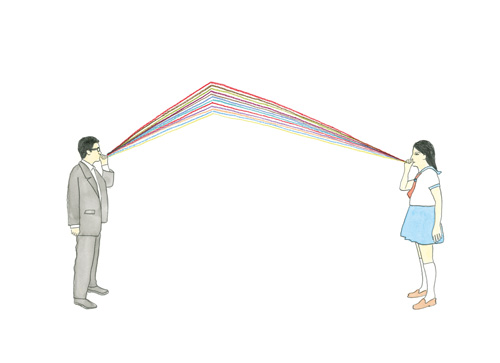

Art by Sydney Pink from Overcoming Creative Block

Such communication in the service of creating something new, Bohm argues, takes place not only between people but within people. He illustrates this with an example that calls to mind Alan Lightman’s beautiful reflection on the creative sympathies of art and science, and writes:

Consider, for example, the work of an artist. Can it properly be said that the artist is expressing himself, i.e., literally “pushing outward” something that is already formed inside of him? Such a description is not in fact generally accurate or adequate. Rather, what usually happens is that the first thing the artist does is only similar in certain ways to what he may have in mind. As in a conversation between two people, he sees the similarity and the difference, and from this perception something further emerges in his next action. Thus, something new is continually created that is common to the artist and the material on which he is working.

The scientist is engaged in a similar “dialogue” with nature (as well as with his fellow human beings). Thus, when a scientist has an idea, this is tested by observation. When it is found (as generally happens) that what is observed is only similar to what he had in mind and not identical, then from a consideration of the similarities and the differences he gets a new idea which is in turn tested. And so it goes, with the continual emergence of something new that is common to the thought of scientists and what is observed in nature.


In a sentiment that affirms the importance of the uncomfortable luxury of changing one’s mind, Bohm adds:

It is clear that if we are to live in harmony with ourselves and with nature, we need to be able to communicate freely in a creative movement in which no one permanently holds to or otherwise defends his own ideas.


He observes that these ideas are rooted in assumptions we hold about various aspects of life — from politics to economics to religion — and those assumptions are what we call our “opinions.” Four centuries after Galileo admonished against the folly of believing one’s preconceptions, Bohm argues that this tendency to cling to our existing opinions is a kind of self-protective “block” we use as a hedge against our fear of uncertainty. But in blocking uncertainty, we also block our ability to listen. Fertile dialogue, he points out, requires that we first become aware of our own “blocks,” then be willing to surmount them. He writes:

When we come together to talk, or otherwise to act in common, can each one of us be aware of the subtle fear and pleasure sensations that “block” his ability to listen freely? Without this awareness, the injunction to listen to the whole of what is said will have little meaning. But if each one of us can give full attention to what is actually “blocking” communication while he is also attending properly to the content of what is communicated, then we may be able to create something new between us, something of very great significance for bringing to an end the at present insoluble problems of the individual and of society.


In a passage of swelling timeliness today, Bohm considers the crucial difference between dialogue and discussion:

“Dialogue” comes from the Greek word dialogos. Logos means “the word,” or in our case we would think of the “meaning of the word.” And dia means “through” — it doesn’t mean “two.” A dialogue can be among any number of people, not just two. Even one person can have a sense of dialogue within himself, if the spirit of the dialogue is present. The picture or image that this derivation suggests is of a stream of meaning flowing among and through us and between us. This will make possible a flow of meaning in the whole group, out of which may emerge some new understanding. It’s something new, which may not have been in the starting point at all. It’s something creative. And this shared meaning is the “glue” or “cement” that holds people and societies together.

Contrast this with the word “discussion,” which has the same root as “percussion” and “concussion.” It really means to break things up. It emphasizes the idea of analysis, where there may be many points of view, and where everybody is presenting a different one — analyzing and breaking up. That obviously has its value, but it is limited, and it will not get us very far beyond our various points of view. Discussion is almost like a ping-pong game, where people are batting the ideas back and forth and the object of the game is to win or to get points for yourself…

In a dialogue, however, nobody is trying to win. Everybody wins if anybody wins. There is a different sort of spirit to it. In a dialogue, there is no attempt to gain points, or to make your particular view prevail. Rather, whenever any mistake is discovered on the part of anybody, everybody gains. It’s a situation called win-win, whereas the other game is win-lose — if I win, you lose. But a dialogue is something more of a common participation, in which we are not playing a game against each other, but with each other. In a dialogue, everybody wins.


Art by Salvador Dalí from a rare 1969 edition of Alice in Wonderland

True dialogue, Bohm argues, not only leads us to question the very assumptions upon which our opinions are built but invites a continual act of self-revision at the level of the thought process itself — the process of which our opinions are a product. This self-revision takes place both on the individual level and on the collective level. He considers the difficulty of rethinking thought itself:

You cannot defend something without first thinking the defense. There are those thoughts which might question the thing you want to defend, and you’ve got to push them aside. That may readily involve self-deception — you will simply push aside a lot of things you would rather not accept by saying they are wrong, by distorting the issue, and so on. Thought defends its basic assumptions against evidence that they may be wrong.


Noting that we engage in two kinds of thought, individual and collective, Bohm points out that most of our individual assumptions are the product of our cultural conditioning and our “collective background.” He writes:

Language is collective. Most of our basic assumptions come from our society, including all our assumptions about how society works, about what sort of person we are supposed to be, and about relationships, institutions, and so on. Therefore we need to pay attention to thought both individually and collectively.


Writing in the same era in which evolutionary biologist Richard Dawkins coined the term “meme,” Bohm adds:

Assumptions or opinions are like computer programs in people’s minds. Those programs take over against the best of intentions — they produce their own intentions.


Those intentions operate on what Bohm calls the “tacit level” — not the level of our conscious awareness but someplace deeper, more intuitive, and almost automatic, of which we only have a vague conscious sense. He explains:

“Tacit” means that which is unspoken, which cannot be described — like the knowledge required to ride a bicycle. It is the actual knowledge, and it may be coherent or not. I am proposing that thought is actually a subtle tacit process. The concrete process of thinking is very tacit. The meaning is basically tacit. And what we can say explicitly is only a very small part of it. I think we all realize that we do almost everything by this sort of tacit knowledge. Thought is emerging from the tacit ground, and any fundamental change in thought will come from the tacit ground. So if we are communicating at the tacit level, then maybe thought is changing.

The tacit process is common. It is shared. The sharing is not merely the explicit communication and the body language and all that, which are part of it, but there is also a deeper tacit process which is common. I think the whole human race knew this for a million years; and then in five thousand years of civilization we have lost it, because our societies got too big to carry it out. But now we have to get started again, because it has become urgent that we communicate. We have to share our consciousness and to be able to think together, in order to do intelligently whatever is necessary. If we begin to confront what’s going on in a dialogue group, we sort of have the nucleus of what’s going on in all society.


But Bohm’s most crucial point — which is also the point most disquieting to our present customs of communication — is that true dialogue must be aimed not at some immediate or practical solution but at the higher-order objective of meaning. A quarter century before physicist Sean Carroll made his beautiful case for “poetic naturalism” as our supreme source of meaning in a universe otherwise devoid of purpose, Bohm writes:

It is not an arbitrary imposition to state that we have no fixed purpose — no absolute purpose, anyway. We may set up relative purposes for investigation, but we are not wedded to a particular purpose, and are not saying that the whole group must conform to that purpose indefinitely. All of us might want the human race to survive, but even that is not our purpose. Our purpose is really to communicate coherently in truth, if you want to call that a purpose.

[…]

It is necessary to share meaning. A society is a link of relationships among people and institutions, so that we can live together. But it only works if we have a culture — which implies that we share meaning; i.e., significance, purpose, and value. Otherwise it falls apart. Our society is incoherent, and doesn’t do that very well; it hasn’t for a long time, if it ever did. The different assumptions that people have are tacitly affecting the whole meaning of what we are doing.


Echoing his magnificent conversation with philosopher Jiddu Krishnamurti about intelligence and love, Bohm adds:

Love will go away if we can’t communicate and share meaning… However, if we can really communicate, then we will have fellowship, participation, friendship, and love, growing and growing. That would be the way…

And perhaps in dialogue, when we have this very high energy of coherence, it might bring us beyond just being a group that could solve social problems. Possibly it could make a new change in the individual and a change in the relation to the cosmic. Such an energy has been called “communion.” It is a kind of participation. The early Christians had a Greek word, koinonia, the root of which means “to participate” — the idea of partaking of the whole and taking part in it; not merely the whole group, but the whole.


On Dialogue remains an illuminating and acutely timely read. Complement it with Einstein on widening our circles of compassion and Carl Sagan on moving beyond “us vs. them,” then revisit Bohm on how our beliefs shape our reality.

Saturday, December 03, 2016

Home Alone

   The concert tonight was the John Williams score to the movie "Home Alone". The Symphony played the music live while the movie ran on 3 large screens set up around the stage. It was surprisingly fun and effective. The hall was sold out and the audience was fun and enthusiastic, laughing and applauding from the opening 20th Century Fox fanfare. They'd all arrived dressed nicely and looking forward to a nice evening. At the end they all stayed for the extended finale after the credits and gave the orchestra and chorus and rousing standing ovation. There's something magical about being in a full theater with an enthusiastic audience for a special screening of a movie that we don't get watching them home alone. A great night!


Wednesday, November 30, 2016

Make the Ordinary Come Alive

By William Martin

Book Review

Sixteen Short NovelsSixteen Short Novels by Wilfrid Sheed

My rating: 4 of 5 stars


“Death is a personal matter, arousing sorrow, despair, fervor, or dry-hearted philosophy. Funerals, on the other hand, are social functions. Imagine going to a funeral without first polishing the automobile. Imagine standing at a graveside not dressed in your best dark suit and your best black shoes, polished delightfully. Imagine sending flowers to a funeral with no attached card to prove you had done the correct thing. In no social institution is the codified ritual of behavior more rigid than in funerals. Imagine the indignation if the minister altered his sermon or experimented with facial expression. Consider the shock if, at the funeral parlors, any chairs were used but those little folding yellow torture chairs with the hard seats. No, dying, a man may be loved, hated, mourned, missed; but once dead he becomes the chief ornament at a complicated and formal social celebration.” - John Steinbeck, Tortilla Flat.

"When there was room on the ledge outside of the pots and boxes for a cat, the cat was there--in sunny weather--stretched at full length, asleep and blissful, with her furry belly to the sun and a paw curved over her nose." - Mark Twain, Pudd'nhead Wilson

"He was a fairly humane man towards slaves and other animals; he was an exceedingly humane man toward the erring of his own race." - Mark Twain, Pudd'nhead Wilson

"He is useless on top of the ground; he ought to be under it, inspiring the cabbages." - Pudd'nhead Wilson's Calendar

" Possibly, I even regret, myself, that I have given so few slaps in the face during my life." - Fyodor Dostoevsky, Notes from Underground

“Above all, don't believe your friends when they ask you to be sincere with them. They merely hope you will encourage them in the good opinion they have of themselves by providing them with the additional assurance they will find in your promise of sincerity.” - The Fall, Albert Camus

"Now was acutely itself: yesterday and tomorrow became the myths." - John Fowles, The Ebony Tower

This is the first book from my friend Mary I've finished and I loved it. I found I love short novels(20,000 - 30,000 words) in general. Longer than short stories, the author can go into more depth and detail and the reader has more to get ahold of. Being shorter than a full length novel the author is forced to be economical and write a tight story. No detracting filler in a novella. And collections of short novels like this one give the reader a variety of writers to experience between one pair of covers.

This volume offers a wide variety of well respected authors. The editor chose excellent examples of the short novel while avoiding selections over-represented elsewhere. I only out-right disliked one(Fowles' The Ebony Tower) and most of the rest make me want to explore more.

I've avoided Faulkner since high school, too thick, but I found Old Man like a delicious Southern gumbo. Steinbeck's Tortilla Flat is light and fun. Ward No. 6 gives us Chekov at the height of his short story powers before he switched to plays. O'Hara's Andrea gives us an interesting study in point of view. The main character is enjoying his unencumbered life and his long-running affair, but suddenly the ending makes it clear it was very different for her. And I discovered a love for Joseph Conrad and Willa Cather.


View all my reviews

Monday, November 28, 2016

Be Like Water: The Philosophy and Origin of Bruce Lee’s Famous Metaphor for Resilience

“In order to control myself I must first accept myself by going with and not against my nature.”

With his singular blend of physical prowess and metaphysical wisdom, coupled with his tragic untimely death, legendary Chinese-American martial artist, philosopher, and filmmaker Bruce Lee(November 27, 1940–July 20, 1973) is one of those rare cultural icons whose ethos and appeal remain timeless, attracting generation after generation of devotees. Inspired by the core principles of Wing Chun, the ancient Chinese conceptual martial art, which he learned from his only formal martial arts teacher, Yip Man, between the ages of thirteen and eighteen. When he left Hong Kong in 1959, Lee adapted Wing Chun into his own version, Jun Fan Gung Fu — literal translation: Bruce Lee’s Kung Fu — and popularized it in America.
In 1971, at the peak of his career, Lee starred in four episodes of the short-lived TV series Longstreet. In one of them, he delivered his most oft-cited metaphor for the philosophy of Gung Fu, based on the Chinese concept of wu wei:

But the famed snippet belies the full dimensionality of the metaphor and says nothing about how Lee arrived at it. Luckily, in Bruce Lee: Artist of Life (public library) — a compendium of his never-before-published private letters, notes, and poems, offering unprecedented insight into his philosophy on life and his convictions about martial arts, love, and parenthood — Lee traces the thinking that originated his famous metaphor, which came after a period of frustration with his inability to master “the art of detachment” that Yip Man was trying to impart on him. Lee writes:
When my acute self-consciousness grew to what the psychologists refer to as the “double-bind” type, my instructor would again approach me and say, “Loong, preserve yourself by following the natural bends of things and don’t interfere. Remember never to assert yourself against nature; never be in frontal opposition to any problems, but control it by swinging with it. Don’t practice this week: Go home and think about it.”
And so he did, spending the following week at home:
After spending many hours meditating and practicing, I gave up and went sailing alone in a junk. On the sea I thought of all my past training and got mad at myself and punched the water! Right then — at that moment — a thought suddenly struck me; was not this water the very essence of gung fu? Hadn’t this water just now illustrated to me the principle of gung fu? I struck it but it did not suffer hurt. Again I struck it with all of my might — yet it was not wounded! I then tried to grasp a handful of it but this proved impossible. This water, the softest substance in the world, which could be contained in the smallest jar, only seemed weak. In reality, it could penetrate the hardest substance in the world. That was it! I wanted to be like the nature of water.
Suddenly a bird flew by and cast its reflection on the water. Right then I was absorbing myself with the lesson of the water, another mystic sense of hidden meaning revealed itself to me; should not the thoughts and emotions I had when in front of an opponent pass like the reflection of the birds flying over the water? This was exactly what Professor Yip meant by being detached — not being without emotion or feeling, but being one in whom feeling was not sticky or blocked. Therefore in order to control myself I must first accept myself by going with and not against my nature.
Bruce Lee (right) with his only formal martial art instructor, Yip Man
Quoting from Lao Tzu’s famous teachings, Lee writes:
The natural phenomenon which the gung fu man sees as being the closest resemblance to wu wei [the principle of spontaneous action governed by the mind and not the senses] is water:
Nothing is weaker than water,
But when it attacks something hard
Or resistant, then nothing withstands it,
And nothing will alter its way.
The above passages from the Tao Te Ching illustrate to us the nature of water: Water is so fine that it is impossible to grasp a handful of it; strike it, yet it does not suffer hurt; stab it, and it is not wounded; sever it, yet it is not divided. It has no shape of its own but molds itself to the receptacle that contains it. When heated to the state of steam it is invisible but has enough power to split the earth itself. When frozen it crystallizes into a mighty rock. First it is turbulent like Niagara Falls, and then calm like a still pond, fearful like a torrent, and refreshing like a spring on a hot summer’s day. So is the principle of wu wei:
The rivers and seas are lords of a hundred valleys. This is because their strength is in lowliness; they are kings of them all. So it is that the perfect master wishing to lead them, he follows. Thus, though he is above them, he follows. Thus, though he is above them, men do not feel him to be an injury. And since he will not strive, none strive with him.
Bruce Lee: Artist of Life is fantastic in its entirety.

Bruce Lee on the Power of Repose and the Strength of Yielding

“One should be in harmony with, and not rebellion against, the strength of the opponent.”

When he emigrated from Hong Kong to America in 1959, Bruce Lee (November 27, 1940–July 20, 1973) adapted the ancient Chinese conceptual martial art Wing Chun into his own version, Jun Fan Gung Fu, literally translated as “Bruce Lee’s Kung Fu,” and popularized it in America. Over the course of his short life, he became not only a trailblazing martial artist but a modern philosopher whose ideas on personal development and the cultivation of character have continued to inspire generations.
On his ascent to superstardom, Lee was too poor to afford long-distance phone calls. Instead, he turned to letters not only as a medium for keeping in touch with his loved ones and collaborators but also as a creative sandbox for fleshing out the ideas that informed his philosophy. Those letters are now collected in Bruce Lee: Letters of the Dragon (public library) — the most direct record of the views, beliefs, and ideals that shaped Lee’s enduring legacy.
In a 1964 letter to Taky Kumura, his first student and one of his dearest friends, 24-year-old Lee outlines the learning process of gung fu. Under the heading “Self-cultivation,” he considers the essential purpose of leisure in spiritual development and writes:
The point where [one is] to rest being known, the object of pursuit is then determined; and, that being determined, a calm unperturbedness may be attained too. To that calmness there will succeed a tranquil repose. In that repose there may be careful deliberation, and that deliberation will be followed by the attainment of the desired end.
Wishing to cultivate oneself, one first rectifies his heart.
Wishing to rectify his heart, one seeks to be sincere in his thoughts.
Wishing to be sincere in his thoughts, one first extends to the utmost of his knowledge — such extension of knowledge lies in the investigation of things.
Only in repose, Lee points out, can the mind begin to investigate the nature of things, empty itself of interferences, and learn not to let external triggers induce internal states of fear, anger, sorrow, and anxiety. He writes of this contemplative space:
A gung fu man rests therein, and because he rests, he is at peace. Because he is at peace, he is quiet. One who is at peace and is quiet, no sorrow or harm can enter; therefore his inner power remains whole and his spirit intact.
Illustration by Maurice Sendak from ‘Open House for Butterflies’ by Ruth Krauss. Click image for more.
Under the captions “NO MIND” and “NO THOUGHT,” Lee adds:
Discard all thoughts of reward, all hopes of praise and fears of blame, all awareness of one’s bodily self. And, finally, [close] the avenues of sense perception and let the spirit out, as it will.
The highest skill operates on an unconscious level.
Sincere thought means thought of concentration (quiet awareness). The thought of a distracted mind cannot be sincere. Man’s mind and his behavior are one, his inner thought and outer expression cannot contradict each other. Therefore a man should set up his right principle and this right mind (principle) will influence his action.
Under the heading “Yielding,” he writes:
Yielding will overcome anything superior to itself; its strength is boundless.
The yielding will has a reposeful ease, soft as downy feathers — a quietude, a shrinking from action, an appearance of inability to do (the heart is humble, but the work is forceful). Placidly free from anxiety one acts in harmony with the opponent’s strength. One does not move ahead but responds to the fitting influence.
In a sentiment he would later hone into his famous metaphor for resilience, Lee adds:
Nothing in the world is more yielding and softer than water; yet it penetrates the hardest. Insubstantial, it enters where no room is. It is so fine that it is impossible to grasp a handful of it; strike it, yet it does not suffer hurt; stab it, and it is not wounded.
Illustration by Shaun Tan for a special edition of the Brothers Grimm fairy tales. Click image for more.
Under the heading “Law of Non-Interfering,” Lee elaborates on this philosophy of yielding as an act of strength:
One should be in harmony with, and not rebellion against, the strength of the opponent.
[…]
The strongest is he that makes use of his opponent’s strength — be the bamboo tree which bends toward the wind; and when the wind ceases, it springs back stronger than before.
Writing to his editor at Black Belt magazine on September 2 of that year, Lee draws a graphic representation of this idea and elaborates on the notion of strength and suppleness as complementary rather than contradictory forces:
Just as an object needs a subject, the person in attack is not taking an independent position but is acting as an assistant. After all, you need your opponent to complete the other half of a whole.
The gentleness/firmness is one inseparable force of one unceasing interplay of movement. If a person riding a bicycle wishes to go somewhere, he cannot pump on both [of] the pedals at the same time or not pump on them at all. In order to move forward he has to pump on one pedal and release the other. So the movement of going forward requires this “oneness” of pumping and releasing, and vice versa, each being the cause of the other.
Bruce Lee: Letters of the Dragon is a trove of timeless wisdom in its entirety. 

"Sorry"

Wednesday, November 23, 2016

Love is not Outside of Us

The real object of our love is not outside of us, the real object of our love is ourselves. We have to know how to love ourselves, know how to return to our true nature, to see the wholesome, the good, the true and the beautiful within us. Then we will be able to see that in others.

~ Thich Nhat Hanh

Web of Life

This we know: all things are connected
Like the blood that unites us.
We did not weave the web of life,
We are merely a strand in it.
Whatever we do to the web, we do to ourselves.

- Chief Seattle

Mama's Kitchen

Two weeks ago I had the good fortune to be honored by Mama's Kitchen as one of their Volunteers of the Year. And my Friday Crew went an extra step and bought me a bouquet of flowers. I was embarrassed to be the center of attention and I ended up taking the most awkward picture I've taken since 1976, but I owed it to all of those good people to accept it graciously.

Saturday, November 19, 2016

Only One Thing is Certain

"There’s only one thing certain. That is one’s own inadequacy. One must start from that." - Franz Kafka

Thursday, November 17, 2016

How to Get Comfortable With Being Uncomfortable

By Chris Dessi

1. Start.

2. Don't quit.

3. Push yourself past your comfort zone.

4. Embrace "the suck."

5. Be around like-minded people.

6. Recognize your improvements.

7. Rinse. Repeat.

Wednesday, November 16, 2016

Beauty in a Parking Lot

I love this photograph by my friend Troy Davidson. Lots of interesting textures, great foreground, middle ground and background, great light and shadow. And it's an ordinary location. Finding beauty in the everyday is a true gift.

Wednesday, November 09, 2016

Food is Love

This is the new Food is Love mural along the stairwell at Mama's Kitchen. This morning I'm worried about Mama's clients. Healthcare is love, too.

Friday, November 04, 2016

Master Yourself

Knowing others is intelligence;knowing yourself is true wisdom.Mastering others is strength; mastering yourself is true power.

~ L. Tzu

Eloquence is Not Wisdom

Don’t think eloquence reveals wisdom. Listening is better than speaking.

~ Rumi
Image: M. Ilhan

Wednesday, November 02, 2016

The Guest House

This being human is a guest house.
Every morning a new arrival.
A joy, a depression, a meanness,
some momentary awareness
comes as an unexpected visitor. Welcome and entertain them all!
Even if they’re a crowd of sorrows,
who violently sweep your house
empty of its furniture,
still treat each guest honorably.
He may be clearing you out
for some new delight.
The dark thought, the shame, the malice, meet them at the door laughing,
and invite them in.
Be grateful for whoever comes,
because each has been sent
as a guide from beyond.

—Rumi; translation by Coleman Barks

Creativity is...

Tuesday, November 01, 2016

Danny Elfman's Music from the Movies of Tim Burton


This was a great concert! The music by itself as played by the San Diego Symphony was exciting and complex, truly thrilling. It was an expanded orchestra with saxophone, piano, harp, and lots of percussion. The large audience was very much into it, many of them arriving in costume. It was a great evening.

Book Review

A Study in Scarlet (Sherlock Holmes, #1)A Study in Scarlet by Arthur Conan Doyle

My rating: 4 of 5 stars


This is the novel that introduces Sherlock Holmes and Dr. Watson to the world. There's an unexpected jump in the middle from London's foggy dampness to the blazing desert of the American Southwest which is really well done. I found this much more engaging than the shorter stories I've read so far.


View all my reviews