“The meaning and purpose of dancing is the dance.” - Alan Watts
As found on Brain Pickings
Showing posts with label Maria Popova. Show all posts
Showing posts with label Maria Popova. Show all posts
Monday, May 22, 2017


Monday, May 15, 2017
Do Not Despise Your Inner World

"Do not despise your inner world. That is the first and most general piece of advice I would offer… Our society is very outward-looking, very taken up with the latest new object, the latest piece of gossip, the latest opportunity for self-assertion and status. But we all begin our lives as helpless babies, dependent on others for comfort, food, and survival itself. And even though we develop a degree of mastery and independence, we always remain alarmingly weak and incomplete, dependent on others and on an uncertain world for whatever we are able to achieve. As we grow, we all develop a wide range of emotions responding to this predicament: fear that bad things will happen and that we will be powerless to ward them off; love for those who help and support us; grief when a loved one is lost; hope for good things in the future; anger when someone else damages something we care about. Our emotional life maps our incompleteness: A creature without any needs would never have reasons for fear, or grief, or hope, or anger. But for that very reason we are often ashamed of our emotions, and of the relations of need and dependency bound up with them. Perhaps males, in our society, are especially likely to be ashamed of being incomplete and dependent, because a dominant image of masculinity tells them that they should be self-sufficient and dominant. So people flee from their inner world of feeling, and from articulate mastery of their own emotional experiences. The current psychological literature on the life of boys in America indicates that a large proportion of boys are quite unable to talk about how they feel and how others feel — because they have learned to be ashamed of feelings and needs, and to push them underground. But that means that they don’t know how to deal with their own emotions, or to communicate them to others. When they are frightened, they don’t know how to say it, or even to become fully aware of it. Often they turn their own fear into aggression. Often, too, this lack of a rich inner life catapults them into depression in later life. We are all going to encounter illness, loss, and aging, and we’re not well prepared for these inevitable events by a culture that directs us to think of externals only, and to measure ourselves in terms of our possessions of externals.
What is the remedy of these ills? A kind of self-love that does not shrink from the needy and incomplete parts of the self, but accepts those with interest and curiosity, and tries to develop a language with which to talk about needs and feelings. Storytelling plays a big role in the process of development. As we tell stories about the lives of others, we learn how to imagine what another creature might feel in response to various events. At the same time, we identify with the other creature and learn something about ourselves. As we grow older, we encounter more and more complex stories — in literature, film, visual art, music — that give us a richer and more subtle grasp of human emotions and of our own inner world. So my second piece of advice, closely related to the first, is: Read a lot of stories, listen to a lot of music, and think about what the stories you encounter mean for your own life and lives of those you love. In that way, you will not be alone with an empty self; you will have a newly rich life with yourself, and enhanced possibilities of real communication with others. - Martha Nussbaum"
Tuesday, January 24, 2017
There are No Bad People
"The more incompetent one feels, the more eager he is to fight." - Dostoevsky
It is our responsibility as human beings, Dostoyevsky suggests, to peer past the surface insecurities that drive people to lash out and look for the deeper longings, holding up a mirror to one another’s highest ideals rather than pointing the self-righteous finger at each other’s lowest faults. - Maria Popova
Wednesday, December 07, 2016
10 Learnings from 10 Years of Brain Pickings
Fluid reflections on keeping a solid center.
BY MARIA POPOVA

I remember my first awareness of mortality as a child in Bulgaria. I was nine and my father was relaying an anecdote from his youth. I asked him when it had taken place. With unconcerned casualness, he replied: “About a decade ago.” I was astonished that people could segment their lives into blocks this big — my own life hadn’t yet lasted a decade. In realizing that “a decade ago” I hadn’t existed — the self I now so vividly experienced daily was then a nonentity — I also realized that in several more of those ten-year blocks, my dad, and eventually I, will cease to exist.
 With dad, year 0
After one such time-block, I left Bulgaria for America, lured by the liberal arts education promise of being taught how to live. As the reality fell short of that promise, I began keeping my own record of what I was reading and learning outside the classroom in mapping this academically unaddressed terra incognita of being.
All the while, I was working numerous jobs to pay my way through school. What I was learning at night and on weekends, at the library and on the internet — from Plato to pop art — felt too uncontainably interesting to keep to myself, so I decided to begin sharing these private adventures with my colleagues at one of my jobs. On October 23, 2006, Brain Pickings was born as a plain-text email to seven friends. Halfway through my senior year of college, juggling my various jobs and academic course load, I took a night class to learn coding and turned the short weekly email into a sparse website, which I updated manually every Friday, then, eventually, every weekday.
The site grew as I grew — an unfolding record of my intellectual, creative, and spiritual development. At the time, I had no idea that this small labor of love and learning would animate me with a sense of purpose and become both my life and my living, nor that its seven original readers would swell into several million. I had no idea that this eccentric personal record, which I began keeping in the city where Benjamin Franklin founded the first subscription library in America, would one day be included in the Library of Congress archive of “materials of historical importance.”
And now, somehow, a decade has elapsed.
Because I believe that our becoming, like the synthesis of meaning itself, is an ongoing and dynamic process, I’ve been reluctant to stultify it and flatten its ongoing expansiveness in static opinions and fixed personal tenets of living. But I do find myself continually discovering, then returning to, certain core values. While they may be refined and enriched in the act of living, their elemental substance remains a center of gravity for what I experience as myself.
I first set down some of these core beliefs, written largely as notes to myself that may or may not be useful to others, when Brain Pickings turned seven (which kindred spirits later adapted into a beautiful poster inspired by the aesthetic of vintage children’s books and a cinematic short film). I expanded upon them to mark year nine. Today, as I round the first decade of Brain Pickings, I feel half-compelled, half-obliged to add a tenth learning, a sort of crowning credo drawn from a constellation of life-earned beliefs I distilled in a commencement address I delivered in the spring of 2016.
Here are all ten, in the order that they were written.
From year seven:
Allow yourself the uncomfortable luxury of changing your mind. Cultivate that capacity for “negative capability.” We live in a culture where one of the greatest social disgraces is not having an opinion, so we often form our “opinions” based on superficial impressions or the borrowed ideas of others, without investing the time and thought that cultivating true conviction necessitates. We then go around asserting these donned opinions and clinging to them as anchors to our own reality. It’s enormously disorienting to simply say, “I don’t know.” But it’s infinitely more rewarding to understand than to be right — even if that means changing your mind about a topic, an ideology, or, above all, yourself.Do nothing for prestige or status or money or approval alone. As Paul Graham observed, “prestige is like a powerful magnet that warps even your beliefs about what you enjoy. It causes you to work not on what you like, but what you’d like to like.” Those extrinsic motivators are fine and can feel life-affirming in the moment, but they ultimately don’t make it thrilling to get up in the morning and gratifying to go to sleep at night — and, in fact, they can often distract and detract from the things that do offer those deeper rewards.Be generous. Be generous with your time and your resources and with giving credit and, especially, with your words. It’s so much easier to be a critic than a celebrator. Always remember there is a human being on the other end of every exchange and behind every cultural artifact being critiqued. To understand and be understood, those are among life’s greatest gifts, and every interaction is an opportunity to exchange them.
Build pockets of stillness into your life. Meditate. Go for walks. Ride your bike going nowhere in particular. There is a creative purpose to daydreaming, even to boredom. The best ideas come to us when we stop actively trying to coax the muse into manifesting and let the fragments of experience float around our unconscious mind in order to click into new combinations. Without this essential stage of unconscious processing, the entire flow of the creative process is broken.
Most important, sleep. Besides being the greatest creative aphrodisiac, sleep also affects our every waking moment, dictates our social rhythm, and even mediates our negative moods. Be as religious and disciplined about your sleep as you are about your work. We tend to wear our ability to get by on little sleep as some sort of badge of honor that validates our work ethic. But what it really is is a profound failure of self-respect and of priorities. What could possibly be more important than your health and your sanity, from which all else springs?
When people tell you who they are, Maya Angeloufamously advised, believe them. Just as important, however, when people try to tell you who you are, don’t believe them. You are the only custodian of your own integrity, and the assumptions made by those that misunderstand who you are and what you stand for reveal a great deal about them and absolutely nothing about you.Presence is far more intricate and rewarding an art than productivity. Ours is a culture that measures our worth as human beings by our efficiency, our earnings, our ability to perform this or that. The cult of productivity has its place, but worshipping at its altar daily robs us of the very capacity for joy and wonder that makes life worth living — for, as Annie Dillard memorably put it, “how we spend our days is, of course, how we spend our lives.”“Expect anything worthwhile to take a long time.” This is borrowed from the wise and wonderful Debbie Millman, for it’s hard to better capture something so fundamental yet so impatiently overlooked in our culture of immediacy. The myth of the overnight success is just that — a myth — as well as a reminder that our present definition of success needs serious retuning. As I’ve reflected elsewhere, the flower doesn’t go from bud to blossom in one spritely burst and yet, as a culture, we’re disinterested in the tedium of the blossoming. But that’s where all the real magic unfolds in the making of one’s character and destiny.
From year nine:
Seek out what magnifies your spirit. Patti Smith, in discussing William Blake and her creative influences, talks about writers and artists who magnified her spirit — it’s a beautiful phrase and a beautiful notion. Who are the people, ideas, and books that magnify your spirit? Find them, hold on to them, and visit them often. Use them not only as a remedy once spiritual malaise has already infected your vitality but as a vaccine administered while you are healthy to protect your radiance.Don’t be afraid to be an idealist. There is much to be said for our responsibility as creators and consumers of that constant dynamic interaction we call culture — which side of the fault line between catering and creating are we to stand on? The commercial enterprise is conditioning us to believe that the road to success is paved with catering to existing demands — give the people cat GIFs, the narrative goes, because cat GIFs are what the people want. But E.B. White, one of our last great idealists, was eternally right when he asserted half a century ago that the role of the writer is “to lift people up, not lower them down” — a role each of us is called to with increasing urgency, whatever cog we may be in the machinery of society. Supply creates its own demand. Only by consistently supplying it can we hope to increase the demand for the substantive over the superficial — in our individual lives and in the collective dream called culture.
And as I round the decade:
Don’t just resist cynicism — fight it actively. Fight it in yourself, for this ungainly beast lays dormant in each of us, and counter it in those you love and engage with, by modeling its opposite. Cynicism often masquerades as nobler faculties and dispositions, but is categorically inferior. Unlike that great Rilkean life-expanding doubt, it is a contracting force. Unlike critical thinking, that pillar of reason and necessary counterpart to hope, it is inherently uncreative, unconstructive, and spiritually corrosive. Life, like the universe itself, tolerates no stasis — in the absence of growth, decay usurps the order. Like all forms of destruction, cynicism is infinitely easier and lazier than construction. There is nothing more difficult yet more gratifying in our society than living with sincerity and acting from a place of largehearted, constructive, rational faith in the human spirit, continually bending toward growth and betterment. This remains the most potent antidote to cynicism. Today, especially, it is an act of courage and resistance.
Tuesday, December 06, 2016
Bruce Lee on Willpower, Emotion, Reason, Memory, Imagination, and Confidence
“You will never get any more out of life than you expect.”
BY MARIA POPOVA

Although Bruce Lee(November 27, 1940–July 20, 1973) is best known for his legendary legacy in martial arts and film, he was also one of the most underappreciated philosophers of the twentieth century, instrumental in introducing Eastern traditions to Western audiences. A philosophy major in college, he fused ancient ideas with his own singular ethos informed by the intersection of physical and psychological discipline, the most famous manifestation of which is his water metaphor for resilience.
Early in his career, Lee was systematically sidelined by Hollywood’s studio system, which operated with extreme racial bias and still used white actors in yellowface to portray Asian characters based on flat stereotypes. Over and over, Lee was told in no uncertain terms that white audiences simply wouldn’t accept an Asian man as a lead character in a movie.
 Bruce Lee (Photograph courtesy of the Bruce Lee Foundation archive)
Even when he finally broke through and was cast as a lead, the studios continued to treat him as a brainless robot, there to entertain with his kung-fu skills. When they tried to cut all the philosophy out of Enter the Dragon because they wanted a vacantly entertaining action movie, Lee refused to go on set for two weeks, insisting that the kung-fu and the philosophy were inextricably entwined, each the vehicle for the other. Hollywood eventually had to relent and it was precisely the philosophical dimension that rendered the movie — just before the release of which Lee met his untimely death — a cultural icon and a beacon of racial empowerment associated with the Black Power movement, later acquired by the Library of Congress as a “culturally, historically, or aesthetically significant” artifact.
Lee saw philosophy as inseparable from everyday life, just as he saw the mind as inseparable from the body, each end of the battery constantly charging the other. He recorded his rigorous workout routine alongside his philosophical meditations, which he fleshed out in the course of living. Like Oliver Sacks, who carried a notebook everywhere, Lee always had a tiny 2×3″ pocketbook with him, which he filled with everything from training regimens to the phone numbers of his pupils (who included trainees like Chuck Norris and Steve McQueen) to poems, affirmations, and philosophical reflections. Even his handwriting, meticulously neat and measured to fit the tiny page, radiates Lee’s formidable discipline and orderliness.
 Bruce Lee (Photograph courtesy of the Bruce Lee Foundation archive)
But perhaps the most notable portion of his pocketbooks — or day timers, as they were called — were his affirmations, reminiscent of the rules of conduct Nobel laureate André Gide penned in his youthful journal and of artist Eugène Delacroix’s diaristic self-counsel. In these notes to himself, Lee articulated his personal philosophies aimed concretely at his own growth but resonating with universally applicable insight into our common psychology, behavior, and human nature.
With special permission from the Bruce Lee estate, here is an exclusive look at several pages from his 1968 pocketbook, penned shortly before Lee’s twenty-eighth birthday, each transcribed below, beginning with Napoleon Hill’s “Daily Success Creed,” which Lee copied into his notebooks:
 Archival material with exclusive permission from the Bruce Lee Foundation archive
WILL POWER: —
Recognizing that the power of will is the supreme court over all other departments of my mind, I will exercise it daily, when I need the urge to action for any purpose; and I will form HABIT designed to bring the power of my will into action at least once daily.
EMOTION: —
Realizing that my emotions are both POSITIVE and negative I will form daily HABITS which will encourage the development of the POSITIVE EMOTIONS, and aid me in converting the negative emotions into some form of useful action.
REASON: —
Recognizing that both my positive & negative emotions may be dangerous if they are not controlled and guided to desirable ends, I will submit all my desires, aims and purposes to my faculties of reason, and I will be guided by it in giving expression to these.
IMAGINATION: —
Recognizing the need for sound PLANS and IDEAS for the attainment of my desires, I will develop my imagination by calling upon it daily for help in the formation of my plans.
MEMORY: —
Recognizing the value of an alert memory, I will encourage mine to become alert by taking care to impress it clearly with all thoughts I wish to recall, and by associating those thoughts with related subjects which I may call to mind frequently.
SUBCONSCIOUS MIND: —
Recognizing the influence of my subconscious mind over my power of will, I shall take care to submit to it a clear and definite picture of my CLEAR PURPOSE in life and all minor purposes leading to my major purpose, and I shall keep this picture CONSTANTLY BEFORE my subconscious mind by REPEATING IT DAILY.
CONSCIENCE: —
Recognizing that my emotions often err in their over-enthusiasm, and my faculty of reason often is without the warmth of feeling that is necessary to enable me to combine justice with mercy in my judgments, I will encourage my conscience to guide me as to what is right & what is wrong, but I will never set aside the verdicts it renders, no matter what may be the cost of carrying them out.
When Lee felt that he had arrived at a particularly significant idea, he wrote it on the unlined back of a plain 3×5″ lined yellow notecard, which he signed, almost like a will or perhaps a contract with himself. He would often refine or copy reflections first recorded in his pocketbook onto the notecards reserved for only his firmest convictions and deepest dedications.
What makes the affirmations especially notable is that they fuse ancient philosophical and spiritual traditions (particularly Zen Buddhism’s ideas about character, the self, and the ego), questionable New Agey magical thinking, and habits of mind which contemporary psychology has since proven fruitful — a reminder that our personhood is a mashup of our era and our culture, with all their inherent knowledges and ignorances, and it is the way we combine the elements at our disposal that makes us who we are.
 Archival material with exclusive permission from the Bruce Lee Foundation archive
You will never get any more out of life than you expect
Keep your mind on the things you want and off those you don’t
Things live by moving and gain strength as they go
Be a calm beholder of what is happening around you
There is a difference a) the world b) our reaction to it
Be aware of our conditioning! Drop and dissolve inner blockage
Inner to outer ~~~ we start by dissolving our attitude not by altering outer condition
See that there is no one to fight, only an illusion to see through
No one can hurt you unless you allow him to
Inwardly, psychologically, be a nobody
 Archival material with exclusive permission from the Bruce Lee Foundation archive
I know that I have the ability to ACHIEVE the object of my DEFINITE PURPOSE in life; therefore I DEMAND of myself persistent, continuous action toward its attainment, and I here and now promise to render such action.
I realize the DOMINATING THOUGHTS of my mind will eventually reproduce themselves in outward, physical action, and gradually transform themselves into physical reality; therefore I will CONCENTRATE my thoughts for 30 min. daily upon the task of thinking of the person I intend to become, thereby creating in my mind a clear MENTAL PICTURE.
I know through the principle of autosuggestion, any desire that I PERSISTENTLY hold will eventually seek expression through some practical means of attaining the object back of it; therefore, I will devote 10 min. daily to DEMANDING of myself the development of SELF-CONFIDENCE.
I have clearly written down a description of my DEFINITE CHIEF AIM in life, and I will never stop trying until I shall have developed sufficient self-confidence for its attainment.
Complement with Lee on the crucial difference between pride and self-esteem, then tune into the excellent new Bruce Lee podcast, in which Lee’s daughter, Shannon, and creative director Sharon Lee unpack his philosophies and discuss how the abiding ideas behind each of his tenets apply to various aspects of our modern lives. You can help keep his legacy alive with a donation to the Bruce Lee Foundation.
The Paradox of Communication: the Crucial Difference Between Discussion and Dialogue
Legendary Physicist David Bohm on the Paradox of Communication, the Crucial Difference Between Discussion and Dialogue, and What Is Keeping Us from Listening to One Another
“If we are to live in harmony with ourselves and with nature, we need to be able to communicate freely in a creative movement in which no one permanently holds to or otherwise defends his own ideas.”
BY MARIA POPOVA

“Words,” Ursula K. Le Guin wrote in her abiding meditation on the magic of real human communication, “transform both speaker and hearer; they feed energy back and forth and amplify it. They feed understanding or emotion back and forth and amplify it.” But what happens in a cultural ecosystem where the hearer has gone extinct and the speaker gone rampant? Where do transformation and understanding go?
What made, for instance, James Baldwin and Margaret Mead’s superb 1970 dialogue about race and identity so powerful and so enduringly insightful is precisely the fact that it was a dialogue — not the ping-pong of opinions and co-reactivity that passes for dialogue today, but a commitment to mutual contemplation of viewpoints and considered response. That commitment is the reason why they were able to address questions we continue to confront with tenfold more depth and nuance than we are capable of today. And the dearth of this commitment in our present culture is the reason why we continue to find ourselves sundered by confrontation and paralyzed by the divisiveness of “us vs. them” narratives. “To bother to engage with problematic culture, and problematic people within that culture, is an act of love,” wrote the poet Elizabeth Alexander in contemplating power and possibility. Krista Tippett calls such engagement generous listening. And yet so much of our communication today is defined by a rather ungenerous unwillingness to listen coupled with a compulsion to speak.
The most perennially insightful and helpful remedy for this warping of communication I’ve ever encountered comes from the legendary physicist David Bohm(December 20, 1917–October 27, 1992) in On Dialogue (public library) — a slim, potent collection of Bohm’s essays and lectures from the 1970s and 1980s, exploring the alchemy of human communication, what is keeping us from listening to one another, and how we can transcend those barriers to mutual understanding.

Decades before the social web as we know it and long before Rebecca Solnit came to lament how our modern noncommunication is changing our experience of solitude and communion, Bohm cautions:
In spite of this worldwide system of linkages, there is, at this very moment, a general feeling that communication is breaking down everywhere, on an unparalleled scale… What appears [in the media] is generally at best a collection of trivial and almost unrelated fragments, while at worst, it can often be a really harmful source of confusion and misinformation.
He terms this “the problem of communication” and writes:
Different groups … are not actually able to listen to each other. As a result, the very attempt to improve communication leads frequently to yet more confusion, and the consequent sense of frustration inclines people ever further toward aggression and violence, rather than toward mutual understanding and trust.
 Art by Ralph Steadman from a rare edition of Alice’s Adventures in Wonderland
Suggesting that the difficulty might arise from our “crude and insensitive manner of thinking about communication and talking about it,” Bohm sets out to restore the necessary subtlety by reclaiming the true meaning of communication and its supreme mastery, dialogue:
“Communication” … is based on the Latin commun and the suffix “ie” which is similar to “fie,” in that it means “to make or to do.” So one meaning of “to communicate” is “to make something common,” i.e., to convey information or knowledge from one person to another in as accurate a way as possible.
[…]
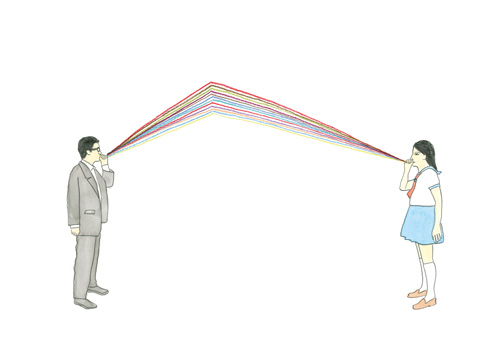
Nevertheless, this meaning does not cover all that is signified by communication. For example, consider a dialogue. In such a dialogue, when one person says something, the other person does not in general respond with exactly the same meaning as that seen by the first person. Rather, the meanings are only similar and not identical. Thus, when the second person replies, the first person sees a difference between what he meant to say and what the other person understood. On considering this difference, he may then be able to see something new, which is relevant both to his own views and to those of the other person. And so it can go back and forth, with the continual emergence of a new content that is common to both participants. Thus, in a dialogue, each person does not attempt to make common certain ideas or items of information that are already known to him. Rather, it may be said that the two people are making something in common, i.e., creating something new together.
But of course such communication can lead to the creation of something new only if people are able freely to listen to each other, without prejudice, and without trying to influence each other. Each has to be interested primarily in truth and coherence, so that he is ready to drop his old ideas and intentions, and be ready to go on to something different, when this is called for.
 Art by Sydney Pink from Overcoming Creative Block
Such communication in the service of creating something new, Bohm argues, takes place not only between people but within people. He illustrates this with an example that calls to mind Alan Lightman’s beautiful reflection on the creative sympathies of art and science, and writes:
Consider, for example, the work of an artist. Can it properly be said that the artist is expressing himself, i.e., literally “pushing outward” something that is already formed inside of him? Such a description is not in fact generally accurate or adequate. Rather, what usually happens is that the first thing the artist does is only similar in certain ways to what he may have in mind. As in a conversation between two people, he sees the similarity and the difference, and from this perception something further emerges in his next action. Thus, something new is continually created that is common to the artist and the material on which he is working.
The scientist is engaged in a similar “dialogue” with nature (as well as with his fellow human beings). Thus, when a scientist has an idea, this is tested by observation. When it is found (as generally happens) that what is observed is only similar to what he had in mind and not identical, then from a consideration of the similarities and the differences he gets a new idea which is in turn tested. And so it goes, with the continual emergence of something new that is common to the thought of scientists and what is observed in nature.
In a sentiment that affirms the importance of the uncomfortable luxury of changing one’s mind, Bohm adds:
It is clear that if we are to live in harmony with ourselves and with nature, we need to be able to communicate freely in a creative movement in which no one permanently holds to or otherwise defends his own ideas.
He observes that these ideas are rooted in assumptions we hold about various aspects of life — from politics to economics to religion — and those assumptions are what we call our “opinions.” Four centuries after Galileo admonished against the folly of believing one’s preconceptions, Bohm argues that this tendency to cling to our existing opinions is a kind of self-protective “block” we use as a hedge against our fear of uncertainty. But in blocking uncertainty, we also block our ability to listen. Fertile dialogue, he points out, requires that we first become aware of our own “blocks,” then be willing to surmount them. He writes:
When we come together to talk, or otherwise to act in common, can each one of us be aware of the subtle fear and pleasure sensations that “block” his ability to listen freely? Without this awareness, the injunction to listen to the whole of what is said will have little meaning. But if each one of us can give full attention to what is actually “blocking” communication while he is also attending properly to the content of what is communicated, then we may be able to create something new between us, something of very great significance for bringing to an end the at present insoluble problems of the individual and of society.
In a passage of swelling timeliness today, Bohm considers the crucial difference between dialogue and discussion:
“Dialogue” comes from the Greek word dialogos. Logos means “the word,” or in our case we would think of the “meaning of the word.” And dia means “through” — it doesn’t mean “two.” A dialogue can be among any number of people, not just two. Even one person can have a sense of dialogue within himself, if the spirit of the dialogue is present. The picture or image that this derivation suggests is of a stream of meaning flowing among and through us and between us. This will make possible a flow of meaning in the whole group, out of which may emerge some new understanding. It’s something new, which may not have been in the starting point at all. It’s something creative. And this shared meaning is the “glue” or “cement” that holds people and societies together.
Contrast this with the word “discussion,” which has the same root as “percussion” and “concussion.” It really means to break things up. It emphasizes the idea of analysis, where there may be many points of view, and where everybody is presenting a different one — analyzing and breaking up. That obviously has its value, but it is limited, and it will not get us very far beyond our various points of view. Discussion is almost like a ping-pong game, where people are batting the ideas back and forth and the object of the game is to win or to get points for yourself…
In a dialogue, however, nobody is trying to win. Everybody wins if anybody wins. There is a different sort of spirit to it. In a dialogue, there is no attempt to gain points, or to make your particular view prevail. Rather, whenever any mistake is discovered on the part of anybody, everybody gains. It’s a situation called win-win, whereas the other game is win-lose — if I win, you lose. But a dialogue is something more of a common participation, in which we are not playing a game against each other, but with each other. In a dialogue, everybody wins.
 Art by Salvador Dalí from a rare 1969 edition of Alice in Wonderland
True dialogue, Bohm argues, not only leads us to question the very assumptions upon which our opinions are built but invites a continual act of self-revision at the level of the thought process itself — the process of which our opinions are a product. This self-revision takes place both on the individual level and on the collective level. He considers the difficulty of rethinking thought itself:
You cannot defend something without first thinking the defense. There are those thoughts which might question the thing you want to defend, and you’ve got to push them aside. That may readily involve self-deception — you will simply push aside a lot of things you would rather not accept by saying they are wrong, by distorting the issue, and so on. Thought defends its basic assumptions against evidence that they may be wrong.
Noting that we engage in two kinds of thought, individual and collective, Bohm points out that most of our individual assumptions are the product of our cultural conditioning and our “collective background.” He writes:
Language is collective. Most of our basic assumptions come from our society, including all our assumptions about how society works, about what sort of person we are supposed to be, and about relationships, institutions, and so on. Therefore we need to pay attention to thought both individually and collectively.
Writing in the same era in which evolutionary biologist Richard Dawkins coined the term “meme,” Bohm adds:
Assumptions or opinions are like computer programs in people’s minds. Those programs take over against the best of intentions — they produce their own intentions.
Those intentions operate on what Bohm calls the “tacit level” — not the level of our conscious awareness but someplace deeper, more intuitive, and almost automatic, of which we only have a vague conscious sense. He explains:
“Tacit” means that which is unspoken, which cannot be described — like the knowledge required to ride a bicycle. It is the actual knowledge, and it may be coherent or not. I am proposing that thought is actually a subtle tacit process. The concrete process of thinking is very tacit. The meaning is basically tacit. And what we can say explicitly is only a very small part of it. I think we all realize that we do almost everything by this sort of tacit knowledge. Thought is emerging from the tacit ground, and any fundamental change in thought will come from the tacit ground. So if we are communicating at the tacit level, then maybe thought is changing.
The tacit process is common. It is shared. The sharing is not merely the explicit communication and the body language and all that, which are part of it, but there is also a deeper tacit process which is common. I think the whole human race knew this for a million years; and then in five thousand years of civilization we have lost it, because our societies got too big to carry it out. But now we have to get started again, because it has become urgent that we communicate. We have to share our consciousness and to be able to think together, in order to do intelligently whatever is necessary. If we begin to confront what’s going on in a dialogue group, we sort of have the nucleus of what’s going on in all society.
But Bohm’s most crucial point — which is also the point most disquieting to our present customs of communication — is that true dialogue must be aimed not at some immediate or practical solution but at the higher-order objective of meaning. A quarter century before physicist Sean Carroll made his beautiful case for “poetic naturalism” as our supreme source of meaning in a universe otherwise devoid of purpose, Bohm writes:
It is not an arbitrary imposition to state that we have no fixed purpose — no absolute purpose, anyway. We may set up relative purposes for investigation, but we are not wedded to a particular purpose, and are not saying that the whole group must conform to that purpose indefinitely. All of us might want the human race to survive, but even that is not our purpose. Our purpose is really to communicate coherently in truth, if you want to call that a purpose.
[…]
It is necessary to share meaning. A society is a link of relationships among people and institutions, so that we can live together. But it only works if we have a culture — which implies that we share meaning; i.e., significance, purpose, and value. Otherwise it falls apart. Our society is incoherent, and doesn’t do that very well; it hasn’t for a long time, if it ever did. The different assumptions that people have are tacitly affecting the whole meaning of what we are doing.
Echoing his magnificent conversation with philosopher Jiddu Krishnamurti about intelligence and love, Bohm adds:
Love will go away if we can’t communicate and share meaning… However, if we can really communicate, then we will have fellowship, participation, friendship, and love, growing and growing. That would be the way…
And perhaps in dialogue, when we have this very high energy of coherence, it might bring us beyond just being a group that could solve social problems. Possibly it could make a new change in the individual and a change in the relation to the cosmic. Such an energy has been called “communion.” It is a kind of participation. The early Christians had a Greek word, koinonia, the root of which means “to participate” — the idea of partaking of the whole and taking part in it; not merely the whole group, but the whole.
On Dialogue remains an illuminating and acutely timely read. Complement it with Einstein on widening our circles of compassion and Carl Sagan on moving beyond “us vs. them,” then revisit Bohm on how our beliefs shape our reality.
Friday, September 02, 2016
This is a Participatory Universe
By Maria Popova
It from Bit: Pioneering Physicist John Archibald Wheeler on Information, the Nature of Reality, and Why We Live in a Participatory Universe
“Reality is what we take to be true,” pioneering physicist David Bohm asserted in 1977. “What we take to be true is what we believe… What we believe determines what we take to be true. What we take to be true is our reality.”
The question of what is true is, of course, invariably a binary one — in answering it, we must choose between true and false. Left or right, the red pill or the blue pill, the ultimate “To be, or not to be.” Information theory is built upon this binary mindset — the if this, then that logic of most programming languages is predicated on the true/false dichotomy in executing commands — and it to this elemental relationship between information and human consciousness that Bohm was speaking.
A little more than a decade later, the great theoretical physicist John Archibald Wheeler (July 9, 1911–April 13, 2008) enriched this idea in a concept he called It from Bit. More than thirty years after he popularized the term “black hole” — a term for the cosmic object which consumes most information into oblivion — Wheeler suggested that our experience of the objects, events, and phenomena that constitute reality is the result of binary decisions — true/false, yes/no, on/off — which we make in the process of observing them.
Wheeler first presented his It from Bit notion at a Santa Fe Institute conference in the spring of 1989. That fall, he formulated it in a paper published under the title “Information, Physics, Quantum: The Search for Links” in the Japanese journal Proceedings of the 3rd International Symposium on Foundations of Quantum Mechanics in the Light of New Technology. It was later discussed in the excellent 1992 essay collection The Mind’s Sky: Human Intelligence in a Cosmic Context (public library) by physicist Timothy Ferris (not to be confused with Tim Ferriss), which is how I was first led down the rabbit hole of obscure academic journals searching for Wheeler’s original text.
By the time of his death, Wheeler was last living link to Einstein and Niels Bohr, with both of whom he had collaborated directly.
In his paper, Wheeler writes:
"I, like other searchers, attempt formulation after formulation of the central issues and here present a wider overview, taking for working hypothesis the most effective one that has survived this winnowing: It from Bit. Otherwise put, every it — every particle, every field of force, even the spacetime continuum itself — derives its function, its meaning, its very existence entirely — even if in some contexts indirectly — from the apparatus-elicited answers to yes or no questions, binary choices, bits."
It from Bit symbolizes the idea that every item of the physical world has at bottom — a very deep bottom, in most instances — an immaterial source and explanation; that what we call reality arises in the last analysis from the posing of yes-no questions and the registering of equipment-evoked responses; in short, that all things physical are information-theoretic in origin and this is a participatory universe.
With an eye to the famous statement that “time and space are modes by which we think and not conditions in which we live” (which Wheeler, like many others, misattributes to Einstein, but which was in actuality thought up by Einstein’s premier biographer, Dimitri Marianoff, in his book Einstein: An Intimate Study of a Great Man), he adds:
"No account of existence can ever hope to rate as fundamental which does not translate all of continuum physics into the language of bits. We will not feed time into any deep-reaching account of existence. We must derive time — and time only in the continuum idealization — out of it. Likewise with space."
Returning to the loop upon which Bohm had puzzled a decade earlier, Wheeler writes:
"Physics gives rise to observer-participancy; observer-participancy gives rise to information; and information gives rise to physics."
His closing sentiment offers a beautiful testament to Einstein’s assertion that “every true theorist is a kind of tamed metaphysicist.” Looking back on the central inquiry animating his It from Bit concept, Wheeler concludes:
"Can we ever expect to understand existence? Clues we have, and work to do, to make headway on that issue. Surely someday, we can believe, we will grasp the central idea of it all as so simple, so beautiful, so compelling that we will all say to each other, “Oh, how — could it have been otherwise! How could we all have been so blind so long!”
Developments like the nascent Golden Age of gravitational astronomy, which owes a great deal to Wheeler’s work, are among the most thrilling such clues in the direction of headway. But before we can arrive at the moment French polymath Henri Poincaré called “sudden illumination,” when the beauty of such greater simplicity is revealed, we must wade through the thicket of greater complexity, the distillation of which is the daily and perennial task of science.
It from Bit: Pioneering Physicist John Archibald Wheeler on Information, the Nature of Reality, and Why We Live in a Participatory Universe
Friday, August 19, 2016
Rationalization is Stronger than Observation
The Benjamin Franklin Effect
“He that has once done you a kindness will be more ready to do you another, than he whom you yourself have obliged.”
By Maria Popova
“We are what we pretend to be,” Kurt Vonnegut famously wrote, “so we must be careful about what we pretend to be.” But given how much our minds mislead us, what if we don’t realize when we’re pretending — who are we then? That’s precisely what David McRaney explores in You Are Now Less Dumb: How to Conquer Mob Mentality, How to Buy Happiness, and All the Other Ways to Outsmart Yourself (public library) — a “book about self-delusion, but also a celebration of it,” a fascinating and pleasantly uncomfortable-making look at why “self-delusion is as much a part of the human condition as fingers and toes,” and the follow-up to McRaney’s You Are Not So Smart, one of the best psychology books of 2011. McRaney, with his signature fusion of intelligent irreverence and irreverent intelligence, writes in the introduction:
"The human mind is obviously vaster and more powerful than any other animal mind, and that’s something people throughout all human history couldn’t help but notice. You probably considered this the last time you visited the zoo or watched a dog battle its own hind legs. Your kind seems the absolute pinnacle of what evolution can produce, maybe even the apex and final beautiful result of the universe unfolding itself. It is a delectable idea to entertain. Even before we had roller skates and Salvador Dalí, it was a conviction in which great thinkers liked to wallow. Of course, as soon as you settle into that thought, you’ll accidentally send an e-mail to your boss meant for your proctologist, or you’ll read a news story about how hot dog-stuffed pizza is now the most popular food in the country. It’s always true that whenever you look at the human condition and get a case of the smugs, a nice heaping helping of ridiculousness plops in your lap and remedies the matter."
This tendency of ours is known as “naïve realism” — the assertion that we see the world as it actually is and our impression of it is an objective, accurate representation of “reality” — a concept that comes from ancient philosophy and has since been amply debunked by modern science. McRaney writes:
"The last one hundred years of research suggest that you, and everyone else, still believe in a form of naïve realism. You still believe that although your inputs may not be perfect, once you get to thinking and feeling, those thoughts and feelings are reliable and predictable. We now know that there is no way you can ever know an “objective” reality, and we know that you can never know how much of subjective reality is a fabrication, because you never experience anything other than the output of your mind. Everything that’s ever happened to you has happened inside your skull."
In sum, we are excellent at deluding ourselves, and terrible in recognizing when our own perceptions, attitudes, impressions, and opinions about the external world are altered from within. And one of the most remarkable of manifestations of this is the Benjamin Franklin Effect, which McRaney examines in the third chapter. The self-delusion in question is that we do nice things to people we like and bad things to those we dislike. But what the psychology behind the effect reveals is quite the opposite, a reverse-engineering of attitudes that takes place as we grow to like people for whom we do nice things and dislike those to whom we are unkind.
This curious effect is named after a specific incident early in the Founding Father’s political career. Franklin, born one of seventeen children to poor parents, entered this world — despite his parents’ and society’s priorities in his favor relative to his siblings — with very low odds of becoming an educated scientist, gentleman, scholar, entrepreneur, and, perhaps most of all, a man of significant political power. To compensate for his unfavorable givens, he quickly learned formidable people skills and became “a master of the game of personal politics.” McRaney writes:
"Like many people full of drive and intelligence born into a low station, Franklin developed strong people skills and social powers. All else denied, the analytical mind will pick apart behavior, and Franklin became adroit at human relations. From an early age, he was a talker and a schemer, a man capable of guile, cunning, and persuasive charm. He stockpiled a cache of secret weapons, one of which was the Benjamin Franklin effect, a tool as useful today as it was in the 1730s and still just as counterintuitive."
[…]
"At age twenty-one, he formed a “club of mutual improvement” called the Junto. It was a grand scheme to gobble up knowledge. He invited working-class polymaths like him to have the chance to pool together their books and trade thoughts and knowledge of the world on a regular basis. They wrote and recited essays, held debates, and devised ways to acquire currency. Franklin used the Junto as a private consulting firm, a think tank, and he bounced ideas off the other members so he could write and print better pamphlets. Franklin eventually founded the first subscription library in America, writing that it would make “the common tradesman and farmers as intelligent as most gentlemen from other countries,” not to mention give him access to whatever books he wanted to buy."
This is where his eponymous effect comes into play: When Franklin ran for his second term as a clerk, a peer whose name he never mentions in his autobiography delivered a long election speech censuring Franklin and tarnishing his reputation. Although Franklin won, he was furious with his opponent and, observing that this was “a gentleman of fortune and education” who might one day come to hold great power in government, rather concerned about future frictions with him.
The troll had to be tamed, and tamed shrewdly. McRaney writes:
"Franklin set out to turn his hater into a fan, but he wanted to do it without “paying any servile respect to him.” Franklin’s reputation as a book collector and library founder gave him a standing as a man of discerning literary tastes, so Franklin sent a letter to the hater asking if he could borrow a specific selection from his library, one that was a “very scarce and curious book.” The rival, flattered, sent it right away. Franklin sent it back a week later with a thank-you note. Mission accomplished. The next time the legislature met, the man approached Franklin and spoke to him in person for the first time. Franklin said the man “ever after manifested a readiness to serve me on all occasions, so that we became great friends, and our friendship continued to his death.”
Instant pause-giver: In what universe does inducing an opponent to do you a favor magically turn him into a supporter? This, it turns out, shares a psychological basis with the reason why the art of asking is the art of cultivating community — and, McRaney explains, it has a lot to do with the psychology of attitudes, those clusters of convictions about and emotional impressions of a person or a situation:
For many things, your attitudes came from actions that led to observations that led to explanations that led to beliefs. Your actions tend to chisel away at the raw marble of your persona, carving into being the self you experience from day to day. It doesn’t feel that way, though. To conscious experience, it feels as if you were the one holding the chisel, motivated by existing thoughts and beliefs. It feels as though the person wearing your pants performed actions consistent with your established character, yet there is plenty of research suggesting otherwise. The things you do often create the things you believe.
Indeed, this is what Gandhi touched on when he observed that our thoughts become our words, our words become our actions, our actions become our character, our character becomes our destiny, and it’s also the foundation of Cognitive Behavioral Therapy, which aims to change how we think by first changing what we do, until we internalize a set of beliefs about how those actions define who we are. McRaney explains how this works:
"At the lowest level, behavior-into-attitude conversion begins with impression management theory, which says you present to your peers the person you wish to be. You engage in something economists call signaling by buying and displaying to your peers the sorts of things that give you social capital… Whatever are the easiest-to-obtain, loudest forms of the ideals you aspire to portray become the things you own, such as bumper stickers signaling to the world you are in one group and not another. These things then influence you to become the sort of person who owns them."
[…]
"Anxiety over being ostracized, over being an outsider, has driven the behavior of billions for millions of years. Impression management theory says you are always thinking about how you appear to others, even when there are no others around. In the absence of onlookers, deep in your mind a mirror reflects back that which you have done, and when you see a person who has behaved in a way that could get you booted from your in-group, the anxiety drives you to seek a realignment."
This brings us to the chicken-or-the-egg question of whether the belief or the display came first. According to self-perception theory, we are both observers and narrators of our own experience — we see ourselves do something and, unable to pin down our motive, we try to make sense of it by constructing a plausible story. We then form beliefs about ourselves based on observing our actions, as narrated by that story, which of course is based on our existing beliefs in the first place. This is what happened to Franklin’s nemesis: He observed himself performing an act of kindness toward Franklin, which he explained to himself by constructing the most plausible story — that he did so willfully, because he liked Franklin after all.
This, as we’ve previously seen in the way we rationalize our dishonesty, is an example of cognitive dissonance, a mental affliction that befalls us all as we struggle to reconcile conflicting ideas about ourselves, others, or a situation. McRaney points to the empirical evidence:
"You can see the proof in an MRI scan of someone presented with political opinions that conflict with her own. The brain scans of a person shown statements that oppose her political stance show that the highest areas of the cortex, the portions responsible for providing rational thought, get less blood until another statement is presented that confirms her beliefs. Your brain literally begins to shut down when you feel your ideology is threatened."
One of the most vivid examples of this process in action comes from a Stanford study:
Students … signed up for a two-hour experiment called “Measures of Performance” as a requirement to pass a class. Researchers divided them into two groups. One was told they would receive $1 (about $8 in today’s money). The other group was told they would receive $20 (about $150 in today’s money). The scientists then explained that the students would be helping improve the research department by evaluating a new experiment. They were then led into a room where they had to use one hand to place wooden spools into a tray and remove them over and over again. A half hour later, the task changed to turning square pegs clockwise on a flat board one-quarter spin at a time for half an hour. All the while, an experimenter watched and scribbled. It was one hour of torturous tedium, with a guy watching and taking notes. After the hour was up, the researcher asked the student if he could do the school a favor on his way out by telling the next student scheduled to perform the tasks, who was waiting outside, that the experiment was fun and interesting. Finally, after lying, people in both groups — one with one dollar in their pocket and one with twenty dollars — filled out a survey in which they were asked their true feelings about the study.
Something extraordinary and baffling had happened: The students who were paid $20 lied to their peers but reported in the survey, as expected, that they’d just endured two hours of mind-numbing tedium. But those who were only paid a dollar completely internalized the lie, reporting even in the survey that they found the task stimulating. The first group, the researchers concluded, were able to justify both the tedium and the lie with the dollar amount of their compensation, but the second group, having been paid hardly anything, had no external justification and instead had to assuage their mental unease by convincing themselves that it was all inherently worth it. McRaney extends the insight to the broader question of volunteerism:
"This is why volunteering feels good and unpaid interns work so hard. Without an obvious outside reward you create an internal one. That’s the cycle of cognitive dissonance; a painful confusion about who you are gets resolved by seeing the world in a more satisfying way."
This dynamic plays out in reverse as well — as the infamous Stanford Prison Experiment, being induced to perform unkind behaviors makes us develop unkind attitudes. It all brings us back to Franklin’s foe-turned-friend:
"When you feel anxiety over your actions, you will seek to lower the anxiety by creating a fantasy world in which your anxiety can’t exist, and then you come to believe the fantasy is reality, just as Benjamin Franklin’s rival did. He couldn’t possibly have lent a rare book to a guy he didn’t like, so he must actually like him. Problem solved."
[…]
"The Benjamin Franklin effect is the result of your concept of self coming under attack. Every person develops a persona, and that persona persists because inconsistencies in your personal narrative get rewritten, redacted, and misinterpreted. If you are like most people, you have high self-esteem and tend to believe you are above average in just about every way. It keeps you going, keeps your head above water, so when the source of your own behavior is mysterious you will confabulate a story that paints you in a positive light. If you are on the other end of the self-esteem spectrum and tend to see yourself as undeserving and unworthy [and] will rewrite nebulous behavior as the result of attitudes consistent with the persona of an incompetent person, deviant, or whatever flavor of loser you believe yourself to be. Successes will make you uncomfortable, so you will dismiss them as flukes. If people are nice to you, you will assume they have ulterior motives or are mistaken. Whether you love or hate your persona, you protect the self with which you’ve become comfortable. When you observe your own behavior, or feel the gaze of an outsider, you manipulate the facts so they match your expectations."
Indeed, Franklin noted in his autobiography: “He that has once done you a kindness will be more ready to do you another, than he whom you yourself have obliged.” McRaney leaves us with some grounding advice:
"Pay attention to when the cart is getting before the horse. Notice when a painful initiation leads to irrational devotion, or when unsatisfying jobs start to seem worthwhile. Remind yourself pledges and promises have power, as do uniforms and parades. Remember in the absence of extrinsic rewards you will seek out or create intrinsic ones. Take into account [that] the higher the price you pay for your decisions the more you value them. See that ambivalence becomes certainty with time. Realize that lukewarm feelings become stronger once you commit to a group, club, or product. Be wary of the roles you play and the acts you put on, because you tend to fulfill the labels you accept. Above all, remember the more harm you cause, the more hate you feel. The more kindness you express, the more you come to love those you help."
So Milton Glaser was right after all when he observed, “If you perceive the universe as being a universe of abundance, then it will be. If you think of the universe as one of scarcity, then it will be.”
You Are Now Less Dumb is excellent in its entirety, exploring such facets of our self-delusion as why we see patterns where there aren’t any, how we often confuse the origin of our emotional states, and more. Complement it with its prequel, then treat yourself to McRaney’s excellent podcast.
Subscribe to:
Posts (Atom)